Euclid and Space Warps: why a lens candidate still needs checking
The project presented by ESA combines AI selection with visual inspection. Its April announcement distinguishes candidate images from confirmed lenses.
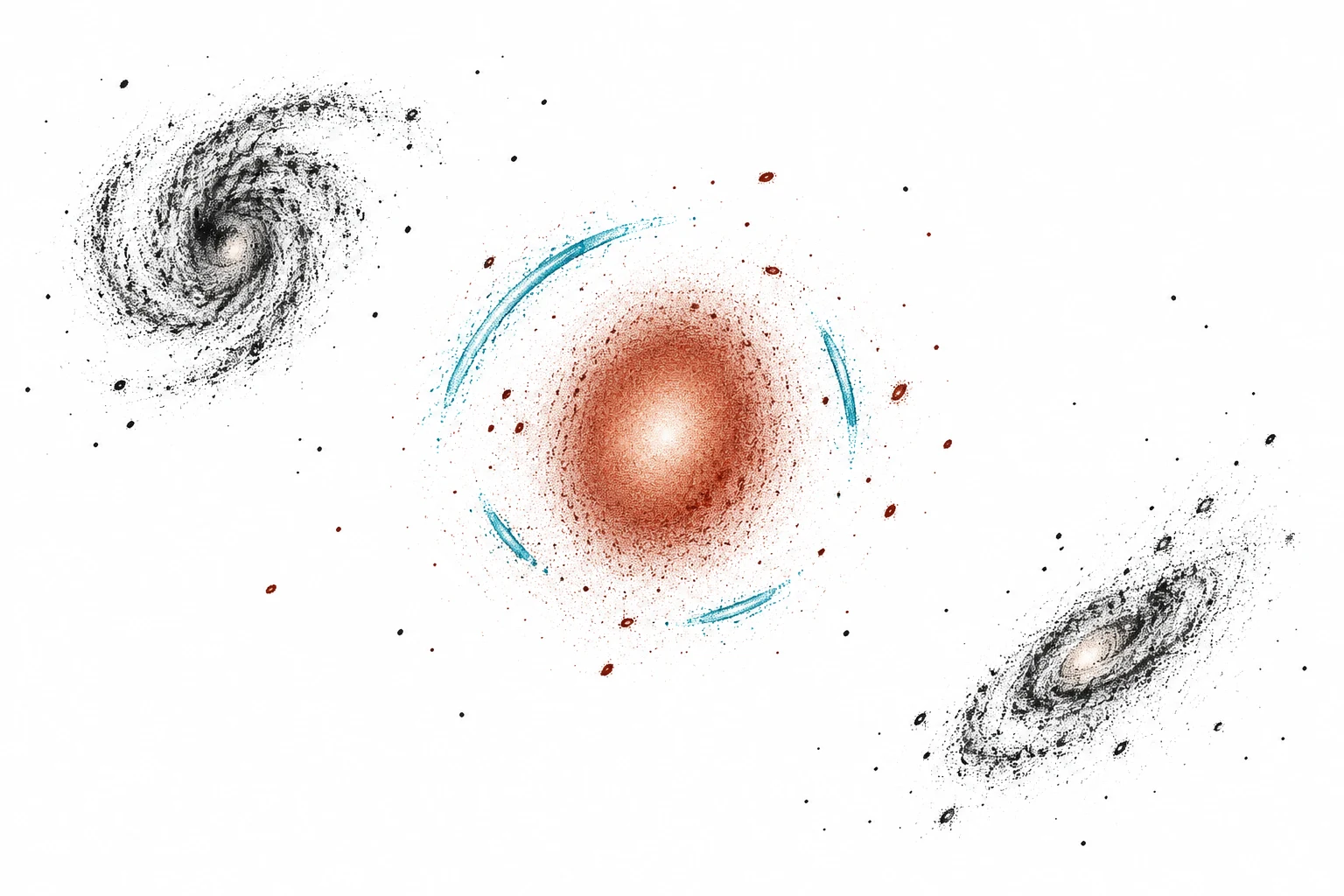
A selection made by artificial intelligence does not turn every image into a discovery. ESA’s announcement of 21 April 2026 about Euclid Space Warps describes around 300,000 candidate images, preselected from 72 million galaxies, for visual inspection by citizen scientists. This article explains that project; it does not present those figures as a new October result or confirm its current progress.
Gravitational lensing occurs when the mass of an intervening object deflects light from another object behind it. Observable shapes include arcs, multiple images and rings. According to ESA, the initial catalogue of March 2025 brought together 500 galaxy–galaxy lenses with contributions from volunteers, AI and researchers. The expectation announced for the new work must not be confused with an already confirmed count.
When reading news of this kind, it helps to sort the numbers into three columns: material examined, candidates selected and objects confirmed. The columns should not be added together as though they were independent discoveries. It is also worth keeping the date of each figure: a forecast written when a project is introduced may continue appearing in searches much later, even though it is not a results update.
One reading test is to cover the headline and look for the verb associated with the main figure. Detecting, proposing and confirming may describe different stages. If a publication does not make the stage clear, there is not enough information to assess its conclusion. The image on this page is a conceptual AI illustration: it cannot be used to locate a galaxy, classify an observation or demonstrate the existence of a particular lens.